| Background Looking at Statistics Technologies Economic/Political Biases The Power Of The Media Is there free press in Sri Lanka? Outside Influences Literacy/Education
|
MEDIA ENVIRONMENT
Outside Influences
 |
|
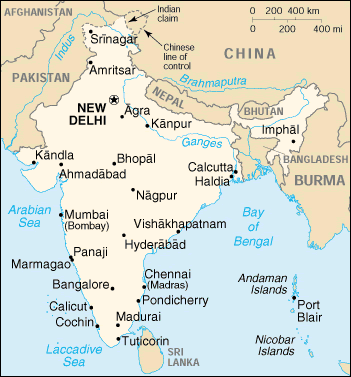
India
is one of the main influences on Sri Lanka -- economically, socially
and culturally. The main difference is that Sri Lanka adopted Buddhism
as its primary religion, which shows an influence from more eastern
cultures, such as China.
|
"The two most important factors in Sri Lanka's foreign relations since 1948 have been a commitment in principle to nonalignment and the necessity of preserving satisfactory relations with India without sacrificing independence" (http://countrystudies.us/sri-lanka/).
No one in Sri Lanka wants to be an appendage to India's regional power ambitions.
In 1977, Sri Lanka took a more western approach, which was motivated by the desire to secure aid in order to promote the government's economic liberalization program. At the same time, Sri Lanka shared with the west apprehensions about India's determination to make the Indian Ocean an Indian sphere of influence (http://countrystudies.us/Sri-Lanka/).
"Some
observers interpreted Sri Lanka's unsuccessful bid in 1982 to gain membership
in the Association of Southeast Asian Nations (ASEAN) as an attempt to
put a little comfortable distance between itself and India" (http://countrystudies.us/Sri-Lanka/).
Trade between countries is another way that the media, economic stability and social structure can change or be influenced.
Sri Lanka depends heavily on its trade with Asian countries. Tourism, textile and tea production/sales, and foreign aid (as the country works through the devastation of the tsunami) by westerners impacts Sri Lanka's wealth, which in turn affects the amount of improvement the government can make based on external revenue.
|
"But
what Asians fear most are further terrorist attacks in America that
would cause a sharp economic downturn," Yew says.
|
"With
tensions easing between India and Pakistan, the South Asian Association
for Regional Cooperation (Bangladesh, Bhutan, India, the Maldives, Nepal,
Pakistan and Sri Lanka) agreed in January to establish an FTA [Free Trade
Agreement] by 2016," says Lee Kuan Yew, senior minister of Singapore.
"Separately, Bhutan, India, Myanmar, Nepal, Sri Lanka and Thailand
signed a framework agreement to work toward reducing tariffs from 2006
onward."
"Over the next 20 years, as hundreds of millions of middle-class Chinese and Indians emerge as hungry consumers, East Asia's dependency on the U.S. will lessen," Yew says. "But in the meantime, any downturn in the US economy will badly affect East Asia. Hence the reason Asians watch anxiously for stronger US economic growth and job creation and are uncomfortable with election rhetoric promising Americans protection against imports and the outsourcing of jobs. But what Asians fear most are further terrorist attacks in America that would cause a sharp economic downturn" (Growing economic integration in Asia).