| Background Looking at Statistics Technologies Economic/Political Biases The Power Of The Media Is there free press in Sri Lanka? Outside Influences Literacy/Education
|
MEDIA ENVIRONMENT
The Power Of The Media
 |
|
Media
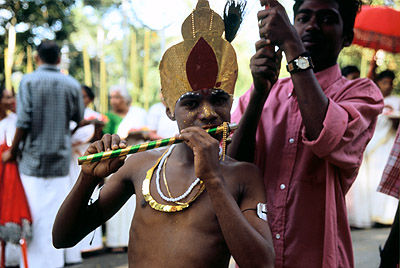
can affect people in the way they dress, the kinds of music they
like and what they enjoy in their free time. This flute player represents
traditional values, which were stressed in the early days of media
production in Sri Lanka.
|
The media of Asia reflects the complex character of this expansive region. In many countries, like Sri Lanka, the media suffers from lack of modern equipment, adequately trained personnel, sufficient financial support, which is compounded by problems with cultural diversity, low incomes, and political controls (5).
Newspapers in Sri Lanka appear in three languages, but those in Sinhalese and Tamil are the most numerous, and those in Sinhalese tend to have the largest circulation and the most influence (5).
High production costs and a shortage of trained producers have forced countries like Sri Lanka to import programs to fill television time, even though such programs have little to do with culture. This trend has weakened as more staff members have become trained, and radio and television organizations are encouraging the work of local writers and performers (5).
"Governments and broadcasters have gradually realized that radio and television can be used effectively to raise the levels of education and literacy, teach technical skills and more efficient farming methods, arose public interest in development projects, further national unity, and do many other things that serve the national and public interest" (5).
 |
|
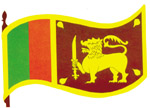
The
lion flag is a symbol of unity, harmony and friendship of all people
- the Sinhala, Tamil and the Yonaka of the ancient time who are
known as Moors.
|
Due to the fact that much of the broadcast in Sri Lanka is state-owned, means that the government has a "knowledge monopoly," which often leaves out minority group opinions, like the Tamils, to the point where war breaks out. The government has a monopoly over the skills necessary to produce the media and controls the later evolution of the society's dominant forms of communication. Whoever owns the media, owns the type of information that audiences receive, which is seen in the government's censorship of topics and events that are against government officials and policies.
The information produced, especially from the government, will only be from one perspective, which can often place itself in opposition to other groups; these groups must also turn to news for education and national support, and what they are receiving is biased. People in Sri Lanka cannot be well-informed if specific kinds of information are not received or even transmitted. In Sri Lanka, in particular, because communication is hard between rural communities, to have information lost at the beginning (through censorship), means that even less information will get to the receiver at the farthest reaches of the nation. A lack of outside perspectives prohibits healthy media development as times change. Television for example could have been slow in coming to the country, because the government did not want to allow outside perspectives (especially during the Tamil conflict) or risk bringing in an uncontrollable media.
There are now many privately owned radio stations and newspapers, which is a good sign that the power of the media is now shifting from the state (the hands of the few) to more individuals. With the creation of an FM station for the Tamils, there is definitely a sign of progress in Sri Lanka.