| Background Looking at Statistics Technologies Economic/Political Biases The Power Of The Media Is there free press in Sri Lanka? Outside Influences Literacy/Education
|
MEDIA ENVIRONMENT
Is there free press in Sri Lanka?
|
"We
went through a bad period in 1989-91, with a near dictatorship,
and one journalist, a friend, was killed. That was the straw that
broke the camel's back, so to speak," Fernando says.
|
"It does work," says Ian Barrow, a history professor at Middlebury College in Middlebury, Vt. "The range of papers is a good indication."
There are approximately eight major newspapers in a country of 19.2 million citizens within 25,332 square miles (65, 610 sq. km).
"Free speech is pretty strong," says Angelo Fernando, who writes for the Sri Lankan media. "Successive governments have tried to censor certain aspects of news, when it came to reporting terrorism activities. They never quite succeeded. We went through a bad period in 1989-91, with a near dictatorship, and one journalist, a friend, was killed. That was the straw that broke the camel's back, so to speak," he says.
 |
|
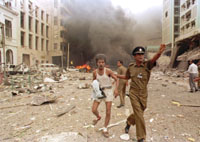
Much
of the media coverage surrounding the Tamil rebellion concentrated
on the heinous acts of violence. Here we see a 2000 car bombing
in Colombo, Sri Lanka's capital.
|
"Right now there may be a veiled censorship, but if you read papers like the Sunday Leader, you will find no evidence of this," he says. "It bashes the president and the cabinet on a full- time basis. The editor was sued, and I think he lost, but nothing has come of it."
The media, over all, seems to be independent from the government (and government sanctions).
"The media is pretty independent, except for the state-run operations," Fernando says. "Rupavahini is the state television station. SLBC [Sri Lanka Broadcasting Corporation] is the radio station, and the Ceylon Daily News (sometimes we call it the Daily Noise!) are the three."
Celia W. Dugger, a reporter from the New York Times disagrees. She says she saw censorship of the media that goes into Sri Lanka and the media it produces.
"Officials also deleted portions of reports by international news agencies that described an opposition rally organized by the United National Party to protest the authorities' sweeping new powers," Dugger writes.
 |
|
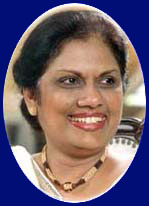
President
Chandrika Kumaratunga was elected in 1994 with a record 62 percent
of the votes cast.
|
"I consider this an issue of national security," said the chief censor, Ariya Rubasinghe, director of information. "We can't afford to have commotion or civil disturbances."
"The regulations announced on Thursday let the government censor articles by foreign reporters and close Sri Lankan newspapers that defy censorship rules," Dugger adds in her article. "Before, local journalists who ignored the censor received written warnings. The government can also seize private property and prohibit strikes, political rallies and criticism of President Chandrika Kumaratunga if it believes that is necessary for security" (Sri Lanka, Limiting reports, Says it pushed back rebels).
Dugger's article was from May 6, 2000, which shows that in the not so distant past, during the height of conflict resolution (or at least attempts to do so) with the Tamil rebels, the government of Sri Lanka felt that it had the right to censor articles that opposed its views in order to preserve security.
Marilyn Cormier says there was a large amount of press censorship 25 years ago when she lived in Sri Lanka.
"I recall as a child that the press did not have the freedom that the press in the United States does," she says. "It didn't seem that you could openly report stuff about the government like you can over here."
The most
recent accounts of Sri Lanka's media environment, especially now that
the rebellion has been mostly settled with peace talks, show Sri Lanka
as having freedom of speech, and government censorship only in extreme
cases.