| Background Looking at Statistics Technologies Economic/Political Biases The Power Of The Media Is there free press in Sri Lanka? Outside Influences Literacy/Education
|
MEDIA ENVIRONMENT
Economic/Political Biases
Civil War: The Tamil "invasion"
 |
|
Coverage
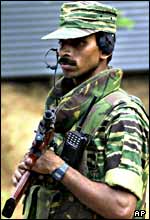
of the Tamil rebellion by the press often caused panic, which heightened
the tensions between the government and the Tamils.
|
"The economic bias in the news depends on which media you analyze," says Angelo Fernando, who writes for the Sri Lankan media. "State TV and radio tend to push a more welfare state bias. The private radio stations are very strong, even in the rural areas, and there are FM Sinhalese and Tamil broadcasts, some of them 24-hours."
The civil war between the Tamil Tigers and the government dominated and biased the media coverage throughout the 1980s and 1990s. The war has been a hurdle for both the government and the media.
|
"Until
weakened by civil war in the past two decades, Sri Lanka offered
the possibility of social development -- good health and education
-- despite relatively low incomes" (6).
|
"The Tamils soon became the preferred target of widespread prejudices and xenophobia in a country that nevertheless continues to pride itself of its mythical tolerance and hospitality" (2).
The coverage of the press, within Sri Lanka, and by other countries, was one of political and social panic, an "illegal invasion" of a huge proportion. The authorities primarily formulated the definition of the situation, of the immigrating Tamils, and the press adopted and communicated this slanted view, thus contributing to the widespread popular resentment against the Tamils (2).
Much of
the social information given to people during the "rebellion"
was through television and newspaper coverage, which shows that much of
the opinion generated thereafter was a product of conditioning by the
media. Due to the constraints of media, certain aspects and stereotypes
of the rebellion were consistently put to the forefront, which could have
spread the panic. The Tamils were characterized negatively and their immigration
represented as a threat to the social status quo (2).
 |
|
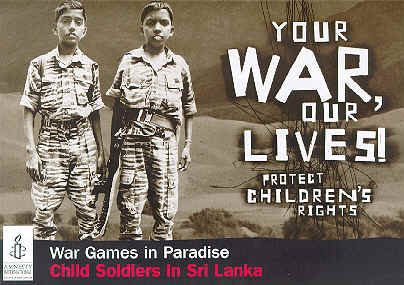
Media
often covered the question of whether the Tamil drafted children
for their war efforts. "It is immoral that LTTE Tamil Tiger
Terrorists want innocent Tamil children to fight the war for them.
There is simply no excuse, no acceptable argument for arming innocent
Tamil children," according to the Society for Peace, Unity
and Human Rights for Sri Lanka (SPUR).
|
The Tamil invasion illustrates that although there may be freedom of the press, sometimes the smaller, minority voices can get lost in all the noise. "Although both Tamils and the government are the central actors of the Tamil story, it is not surprising that the former say less than the latter: Tamil refugees or their representatives are quoted very little" (2).
"Until weakened by civil war in the past two decades, Sri Lanka offered the possibility of social development -- good health and education -- despite relatively low incomes" (6).
The war cost 6 percent of the GDP, and despite modest foreign assistance, Sri Lanka was forced to print money to pay its debts. During the tension and attacks, the government neglected to improve roads, electricity and other utilities. The country is one of a few of its size without an expressway (6).
Coupled with the devastation of the war and the Dec. 26 tsunami, Sri Lanka will always have a different perspective, a biased perspective, concerning events of this nature and magnitude.
Propaganda
 |
|
Sometimes
the media can act as the voice of the government, which is detrimental
to the everyday person who needs an unbiased view to understand
where Sri Lanka fits in the world.
|
"The effective utilization of mass media for kicking off and sustaining economic growth depends, beyond any other single factor, on the nature of ownership of media, and partly as a corollary to this, on credibility" (1).
Following the formation of the Ceylon Broadcasting Corporation (CBC), objectives were outlined to use radio to help in Sri Lanka's "terrible ascent" from "stagnation to growth." This was a departure from the usual practice of broadcast as entertainment (1).
"The CBC commitment to developmental goals included a mass orientation of all programs to explain economic and social reconstruction in ways that people would see benefits from their participation" (1).
As a result of the new program, CBC was criticized as being a tool or propaganda instrument for the government. The need for radio to be freed from the constrains of government would enable people to develop trust and credibility in the medium. But major political parties in Sri Lanka still hang on to radio, making it their tool.
"Some
papers, I know, are mouthpieces of the government," says Ian
Barrow, a history professor at Middlebury College in Middlebury, Vt.