| Background Looking at Statistics Technologies Economic/Political Biases The Power Of The Media Is there free press in Sri Lanka? Outside Influences Literacy/Education
|
MEDIA ENVIRONMENT
Technologies
Dominating Media Technologies
According to BBCNews. com, Sri Lanka's media outlets are divided along language and ethnic lines. State-run and private operators offer services in the main languages (Sinhala and Tamil).
|
"In
the cities, the Internet is becoming more important, but it is still
largely an upper-class distraction," Barrow says.
|
Newspapers and radio are the dominating form of communication within Sri Lanka, says Ian Barrow, a history professor at Middlebury College in Middlebury, Vt.
 |
|
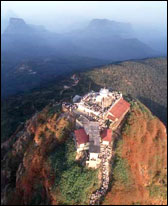
The
rough terrain and unpredictable, tropical climate, make it hard
for there to be clear lines of communication between rural communities.
|
"Newspapers and radio [because of their] distribution and ease of access. In the cities, the Internet is becoming more important, but it is still largely an upper-class distraction," Barrow says.
According to BBCNews. com, there are approximately eight major newspapers in Sri Lanka, including the Daily News, The Island, Daily Mirror and Dinamina. Some are state-owned, some are privately-owned and some appear in only English, Sinhala or Tamil.
There are two major news agencies -- Lankapuvath (state-owned) and TamilNet (Tamil news service). The Sinhalese, in this light, do not have their own specific voice within news agencies.
Although television has been introduced into Sri Lanka (and other Asian countries such as Pakistan and Bangladesh), radio is by far the most important broadcast medium, according to John Merrill, author of Global Journalism: A Survey of the World's Mass Media (5).
Others disagree.
"TV is somehow still a big influence, and newspapers seem to lag behind TV and radio," says Angelo Fernando, who writes for the Sri Lankan media. He sees the influence of television, with its fast-paced messages, as a larger influence than both radio and newspapers.
The influence of television may be greater, in the sense that it brings other cultures to Sri Lanka, but more people have access to radio and newspapers, and these two media are the major means in which people get their news (as opposed to the entertainment value brought by television).
Other Technologies
 |
|
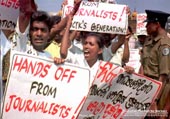
Some
minority groups, like the Tamil, feel that the government tries
to censor them.
|
Press/Broadcasting: Sri Lanka's broadcasting is a state monopoly, organized under the Sri Lanka Broadcasting Corporation (SLBC), which is in turn split into three language services: Sinhalese, Tamil and English. External broadcasts of SLBC are carried by four services: All Asia English Commercial, All Asia Hindi Commercial, All Asia Tamil Commercial and Overseas Service (1).
Broadcasting in Sri Lanka is primarily financed through license fees and revenue from the Commercial Service (1).
Sri Lanka's privately-owned press, separate from the government-run SLBC, often engages in political debate, which criticizes government policies (BBCNews.com).
Broadcasting through much of Asia and the Pacific is mainly national, controlled by government departments or government-created corporations. Privately owned broadcast stations are allowed in some nations, but they operate under much closer government supervision than do print media (5).
Radio: An estimated 45 percent of Sri Lanka's population listens to radio. Radio is important to Sri Lanka because it is inexpensive, requires fewer well-trained personnel for setup, and it is able to cross a multitude of languages and cultures (especially between the Tamil and Sinhalese) (5). There are more than a dozen privately owned radio stations.
In 2002, during peace agreements with the Tamil, the government did permit Tamil Tiger rebels to begin FM broadcasts of their Voice of Tigers radio station in the north portion of the island. "The station had previously operated on a clandestine basis" (BBCNews.com).
Other major radio station owners, other than SLBC, are TNL Radio (English, private), Sun FM (English, private) and Yes FM (English, private). There are also three Sinhala stations and two Tamil stations.
Radio is important in nations with large rural populations, like Sri Lanka, because in some cases it provides the only means of rapid and effective communication between populated areas (5).
|
"Information and communication have
become the basic tools of the poor in their efforts to improve their
lives," says Anura Priyadarshana Yapa, Sri Lanka's minister
of information and the media.
|
Television: Television has gained more dominance since the 1980s, during the Tamil rebellion. The vivid imagery often created a sense of panic, which impacted tourism, government actions and forced many Sri Lankans to consider moving out of the country (and many did).
There are eight privately-run television stations and a range of state, private and ethnically divided media outlets. Some major owners are Sri Lanka Rupavahini Corporation (SLRC), the Independent Television Network (ITN), which is Sri Lanka's first television station, and Sirasa TV. There is some influence of western culture, not only in the use of English programming, but also in the presence of MTV within the top five most watched broadcasting companies (BBCNews.com).
Telephones: Domestic service in Sri Lanka is inadequate. Most rural communities have not developed a strong network of communications through this media. Mobile phones are also not used frequently because of their expense and the poor system available.
The Internet: The Internet is still not as dominate as cheaper means, such as television and radio. Sri Lankan media workers say they think that once the Internet is fully integrated into the system the divide between the media "haves" and the media "have nots" will lessen tremendously.
 |
|
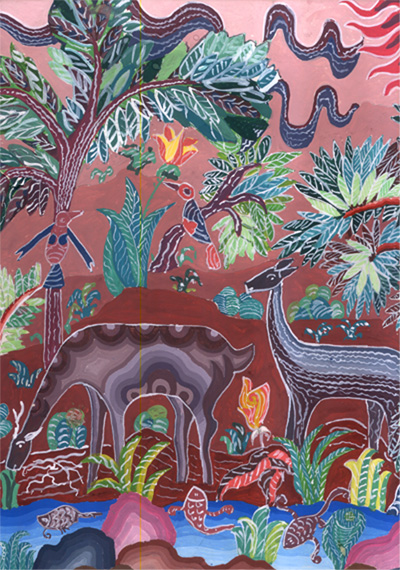
Lanka
Academic Network works to popularize and promote the use of computers
and the Internet in Sri Lanka by providing computer and Internet
access to rural and undeserved urban communities. Cover painting
© W.M. Susanthakumara Nawarathne,
Grade 13, for the Quarterly Magazine of the Computer Centre. |
The Lanka Academic Network organization works to help bring computers to rural areas. "Lack of resources has prevented many communities in Sri Lanka from gaining access to computers and the Internet, which in turn deprives the country of citizens with basic skills needed for her to move forward as a technologically advanced society" (LAcNet www.lacnet.org).
Combining old technology with new technology is one way that people are trying to integrate media to gain a better understanding of the world and learn the skills necessary to compete in that world.
"By linking Internet access with community radio, rural people can plug into the world's knowledge banks. Radio stations have broken new ground in community broadcasting and communication services by marrying a 'traditional technology' -- radio -- with a new one -- the Internet. In doing so, it has also proved that the so-called digital divide can be bridged. 'Information and communication have become the basic tools of the poor in their efforts to improve their lives,' says Anura Priyadarshana Yapa, Sri Lanka's minister of information and the media. 'Bringing power of knowledge to the people enables them to defeat poverty and enhance the quality of their lives'" (Crossing the great divide).
The government is working slowly to broaden the reach of the Internet.
"Internet penetration is still low, because it is mainly in the urban areas," Fernando says. "Having said that, many rural projects have community centers that bring the Internet to the village."
Barrow says he believes that within the next 10 years, both mobile phones and the Internet will become more prominent forms of media within Sri Lanka.