|
1
|
- Online teacher training in CALL
|
|
2
|
- PURPOSE
- To deliver a teacher training course ONLINE in Computer-Assisted
Language Learning (CALL) to current SMC graduate students and alumni
- REASONS
- allow participants to earn credits toward a master’s degree at SMC
- continue professional obligations while at the same time improving
credentials (Master’s degree, (re)certification, or job advancement)
- reduce travel and accommodations cost for faculty and students
- allow participants to remain in their country and pursue a career
- TARGET AUDIENCE
- Originally (1999/2000):
- partner institutions/satellite campuses of MATESL during the academic
year (Hellenic American Union in Athens, Gama Bell School in Krakow,
Poland)
- Currently:
- Any MATESL student who lives/ works abroad (Switzerland, South Pacific,
Canada, Greece, Poland)
- On-campus students in MATESL, MEd, and MSA programs
- Public school teachers/staff around the state of Vermont and in
neighboring states (New York); distance too great to travel
- Alumni of SMC (undergrad or grad)
|
|
3
|
- In authoring this CALL
course, I echo Warschauer's belief that
- "the literacies of accessing and publishing Web-based information
must also become part of English language teaching curricula. New electronic
literacies ... include computer literacy (i.e., comfort and fluency in
keyboarding and using computers), information literacy (i.e., the
ability to find and critically evaluate online information), multimedia
literacy (i.e., the images, and sounds), and computer-mediated
communication literacy (i.e., knowledge of the pragmatics of individual
and group online interaction)”
(A Developmental Perspective on Technology in Language Education,
TESOL Quarterly 36,(3), Autumn 2002, p. 455)
|
|
4
|
- to provide an online teacher training experience through online CALL
that parallels the experience that the students have in the face-to-face
course
- My premise: Whatever I and the students do/did in the face-to-face
course, should also happen in the online course. I have to find ways to make this
possible.
- to find ways to create the same kind of effective, involved,
enthusiastic learning community that existed in my face-to-face classes
- To model the course goal—effectively incorporating technology into the
classroom—by providing hands-on, task- and project-based experiences, that
follow a constructivist, inquiry-based approach
- Construction of learning and teaching principles by the group rather
than receiving information through lectures
- The teacher as facilitator, not the “sage of the stage”
- Autonomous Learners taking responsibility for their own learning
|
|
5
|
|
|
6
|
|
|
7
|
|
|
8
|
- How were the goals accomplished?
- Content:
- Participants learn through hands-on and task-based activities how to incorporate
computer technology into lessons that enhance the skills of English
language learners.
- Reviews of research in online discussions, group analyses, and chats
regarding the effectiveness of various media; critical evaluation of
web sites and software, including those for K-12 teaching
- Online Tutorials (Word, PPT, FP): mastering the technology (HOW TO’s)
- Process:
- 14 weekly modules, theme/topic-based; no regularly scheduled physical
meeting times, but participants need to "check in" at least
3-4 per week
- Time on task in this 3-credit course: Course work corresponds to the
37.5-hour requirement for graduate courses at SMC (I have scheduled 14
weeks worth of "Tasks" and "Assignments“
- rough time estimate: 3 hours of intensive work on tasks plus twice
the number of hours (= 6 hours) for hands-on preparation and regular
weekly assignments
- Prerequisite skills/hardware:
- Familiarity with the Windows operating system (Win98 or higher), basic
file management, Internet navigation, e-mail, and word processing.
Students must be able to store large files (e.g. Zip or CD-RW disks).
|
|
9
|
- Teaching method: Using constructivist, inquiry and project-based
learning principles that encourage collaboration and interaction
- Hands-on tasks and projects (weekly, short-term, and semester-long):
- Experimentation with applications, Internet tools, and links (= tasks)
- Constructing teaching tools that make use of what they learned (a
class/school newsletter in Word, a PowerPoint slide show that is a
lesson plan for a WebQuest, a FrontPage-based WebQuest lesson,
web-based rubrics for assessment of student projects, ) (= Hands-on
Projects)
- Sharing with the class what they learned about each task (threaded
discussion)
- Group tasks that require the use of online collaboration tools for
communication and file sharing, as well as peer reviewing
- Weekly summaries/reactions to
- Required and personally selected readings (Reading Discussion forum;
threaded discussion)
- Hands-on links (Tasks; Sharing what you learned Disc. forum; threaded
disc.)
- Class members’ questions and comments
- Class members’ short- and long-term projects (peer reviews)
|
|
10
|
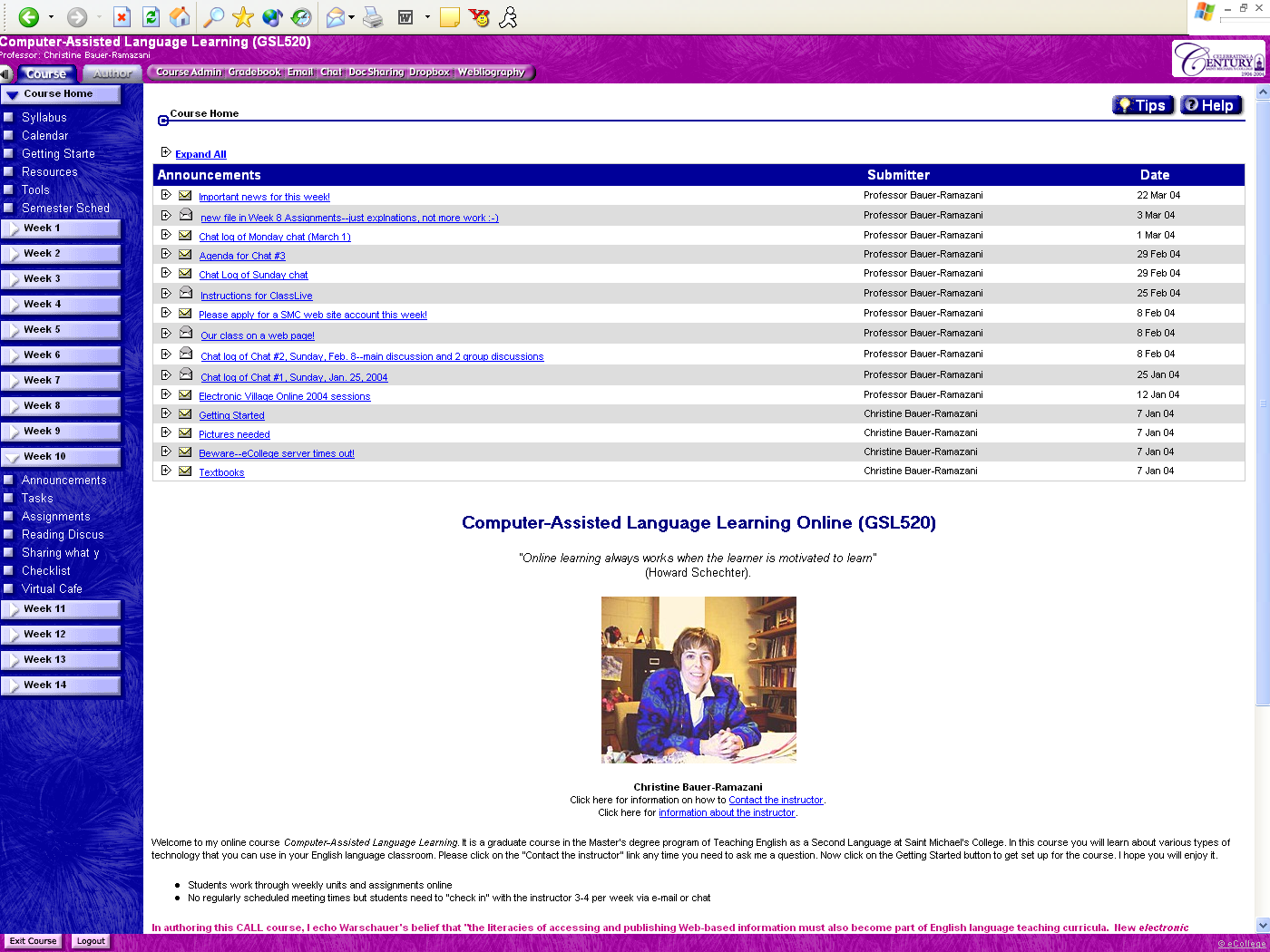
- Online course delivery
- Design:
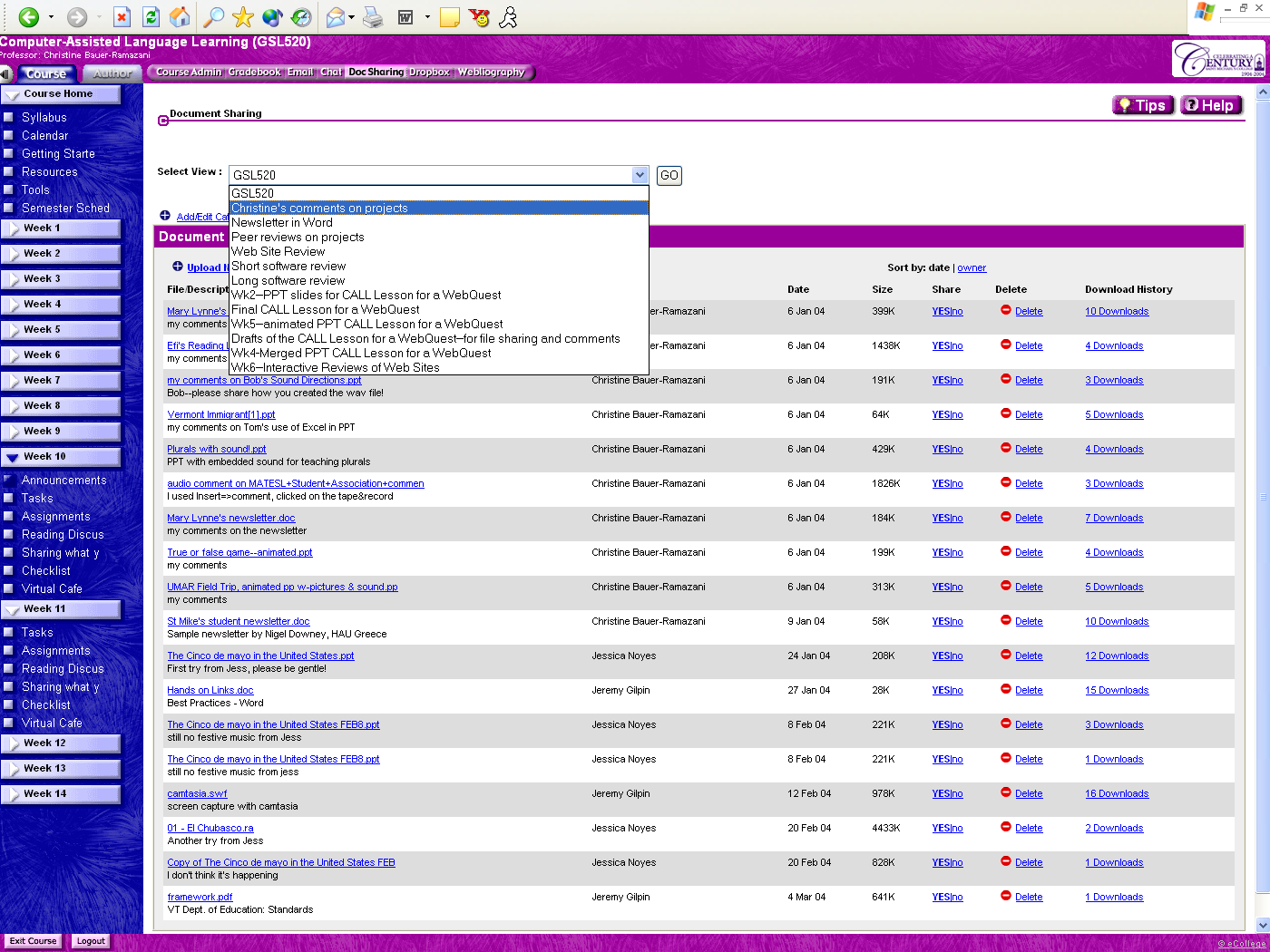
- Simple course architecture in eCollege--easy to navigate
- Consistent course/page design and layout
- Clear instructions/policies/guidelines/deadlines; frequent repetition (reminders)
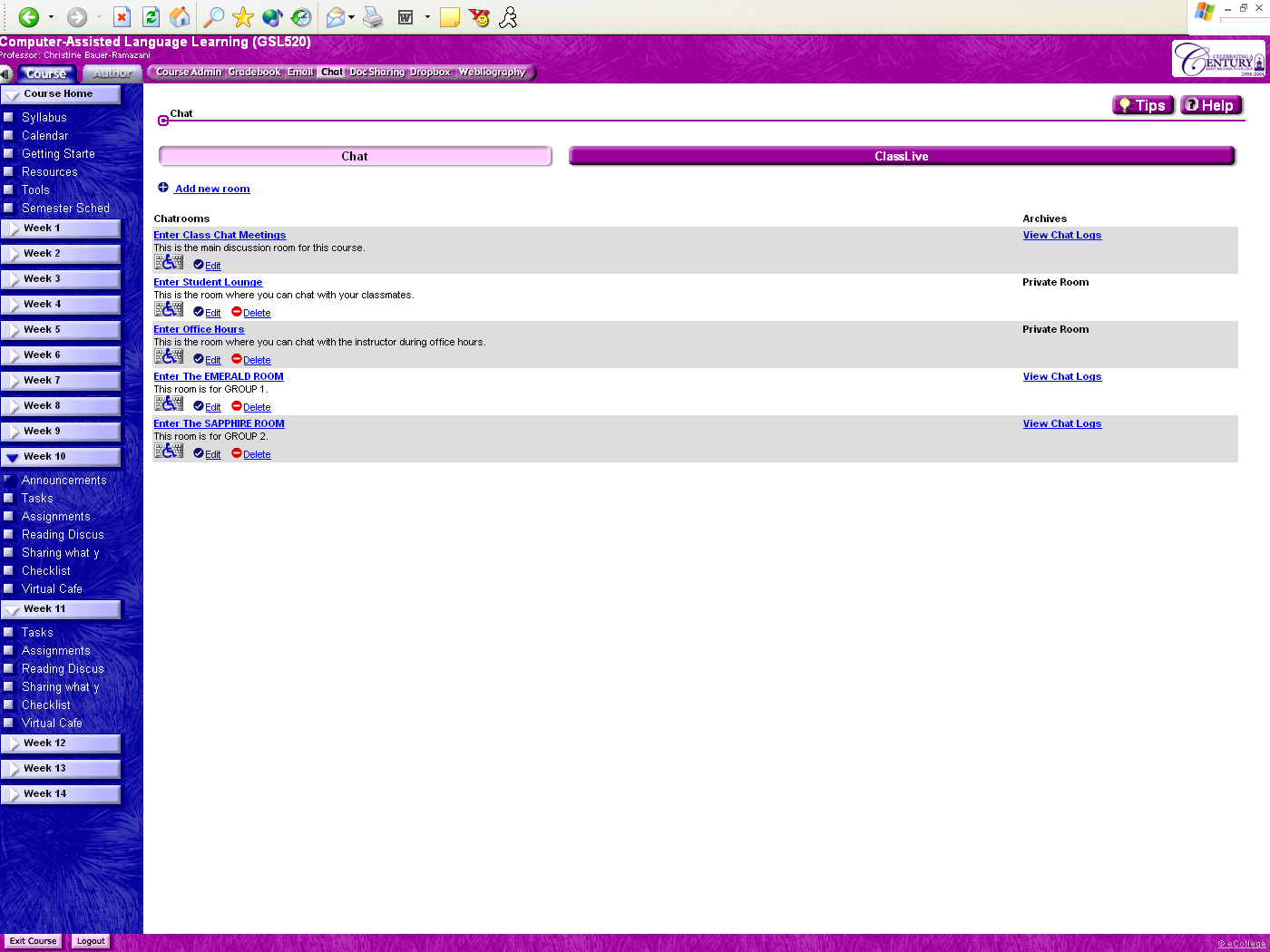
- Tools: computer-mediated communication to establish an effective
learning community
|
|
11
|
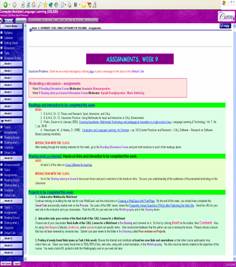
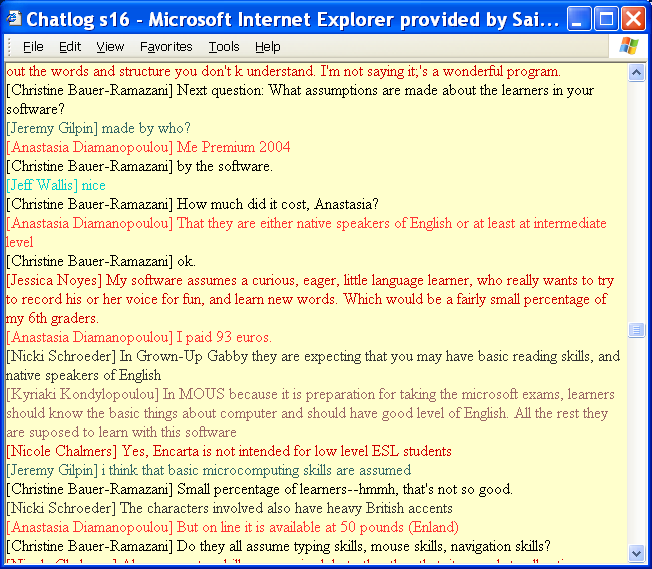
- Asynchronous communication
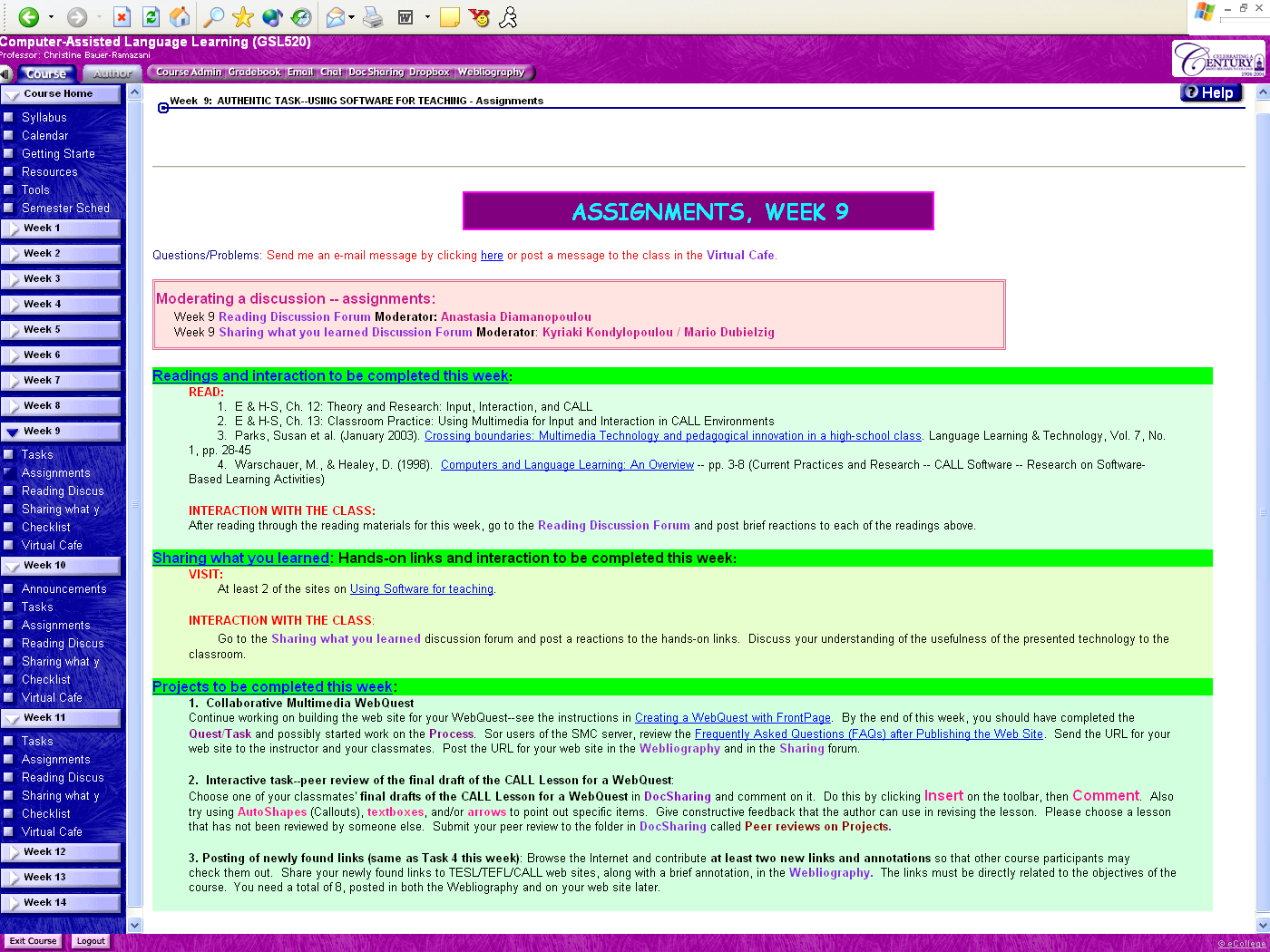
- Assignment of moderators to lead the weekly threaded discussion forums
about readings and hands-on tasks/projects
- Class discussions (readings/links/tasks)
- Interaction (peer reviews of projects)
- File sharing (submitting hands-on projects, submitting newly-found web
links and WebQuest links;
- E-mail exchanges: class/group/private
- A teacher-constructed web page with the picture and brief bio of each
course participant
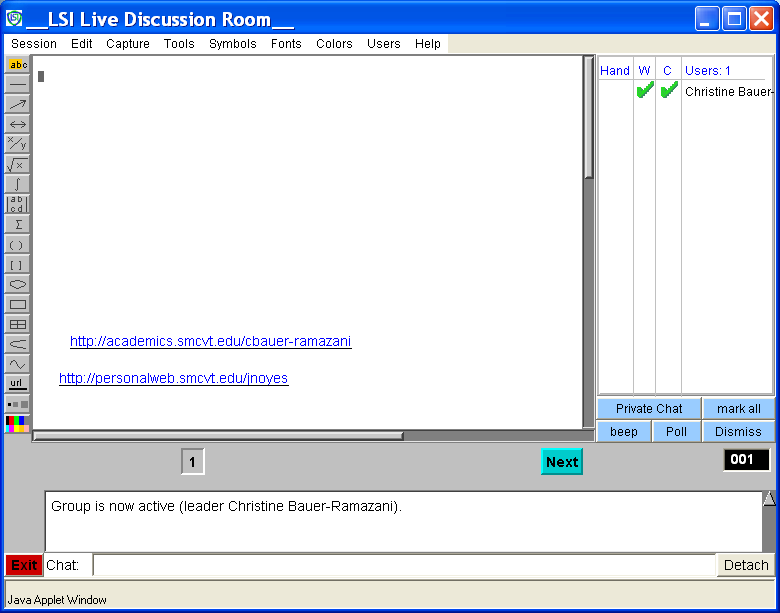
- collaboration (group tasks—synchronous & asynchronous)
|
|
12
|
|
|
13
|
|
|
14
|
|
|
15
|
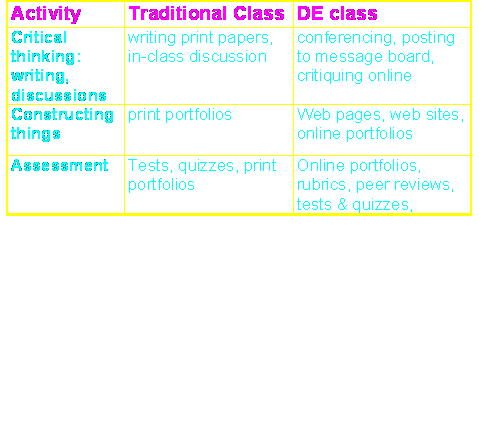
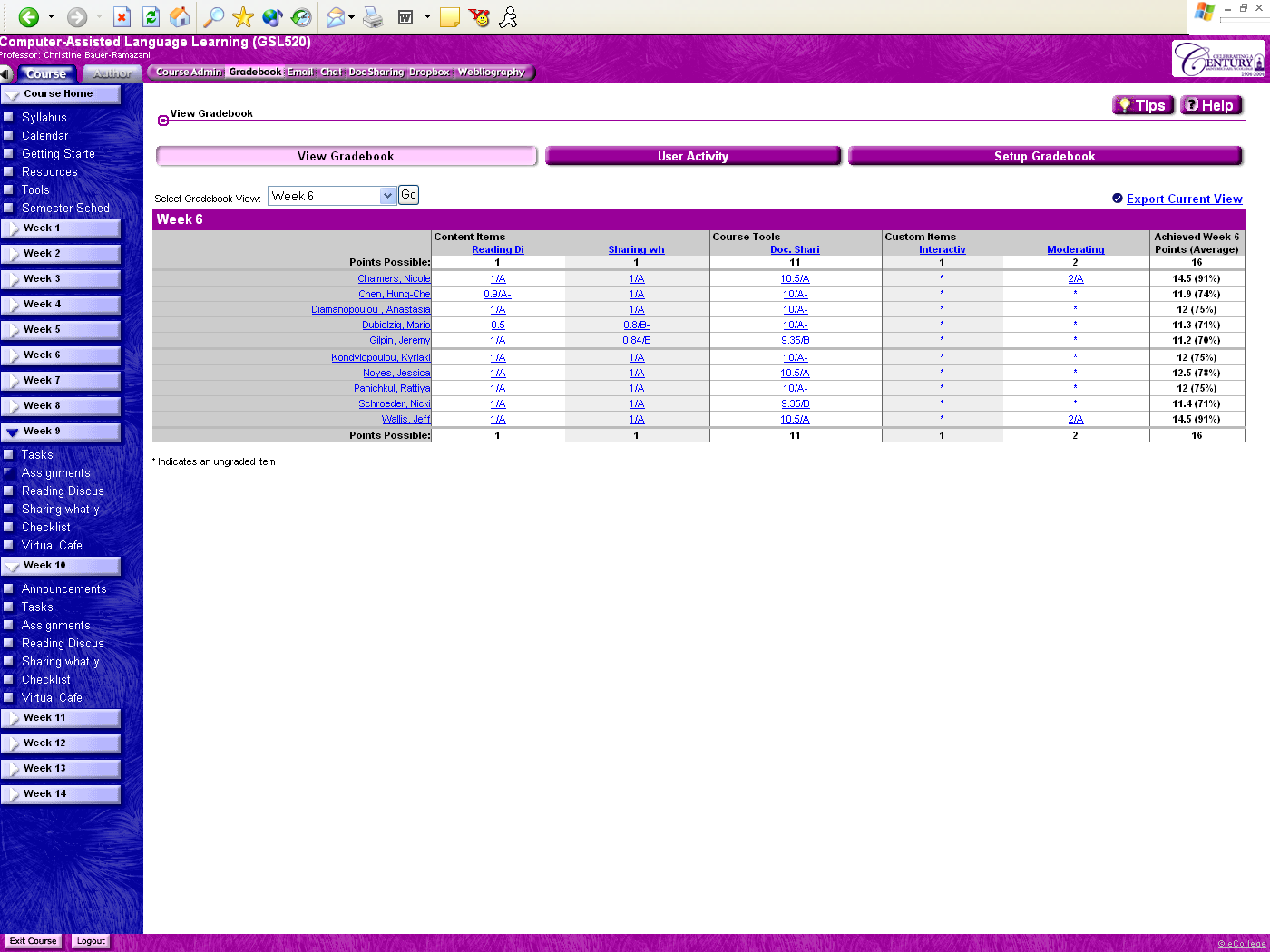
- In Constructivist Learning Theory, learning is assessed through performance–based
projects rather than through traditional paper and pencil testing.
- Interaction with the class: 43%
- Posting of reactions to articles: (14%) – 14 articles,
1 summary reaction per week; 1 point per week; extra credit for more
than 14 summary reactions
- Sharing what you
learned:
(14%) – 14 weeks; 3 responses total per week; 1 point per week
- Moderating a
discussion: (
6%) – 3 times required, including Reading Forum and Sharing
forum – 2 points per turn as moderator for a total of 6
points
- Interactive Tasks--peer reviews of classmates' projects (5%) -- 5
tasks; 1 point each
- Posting of newly found links: 4% -- 8 links min.; ½ point
per link
- Hands-on projects: 14% -- 7 projects; 2 points per
project
- Two in-depth Reviews: 20%
- Web Site Review: (10%) – 10 points
for completion
- Software Review: (10%) – 10 points
for completion
- Multimedia WebQuest: 23%
- Part 1: PowerPoint CALL Lesson (11%) -- 11 points for completion
- Part 2: WebQuest on the web (12%) – 12 points for completion
________________________________________________________________
TOTAL:
100% -- 100 points
- Note: penalties for late submission
|
|
16
|
|
|
17
|
|
|
18
|
- A more learner-centered and higher quality experience than the
face-to-face course
- Student comments: “Tremendous learning experience: exposure to a wealth
of resources & media”
- Carefully thought-out/substantive/stimulating interaction
- Everybody participates ALL THE TIME.
- High quality of output—projects and discussions
- Continual exploration to find ways to incorporate newly learned
tools/methods/aspects
- Accomplishment of course goals
|
|
19
|
- Unsolicited student quotes (from current threaded discussions):
- Can you believe we're already 6 weeks in? It's been great learning
from everyone thus far.
- I am as enthusiastic as you are. Our voice conference this weekend was
something I really enjoyed. It's amazing how computers can bring
together people and students from all around the world.
- How exciting to speak to someone in Greece, and not have to pay long
distance, AND to be collaborating on a project together. It was
wonderful!
- Once again, the learning in this course is just endless for me!
|
|
20
|
- Scheduling real-time chats across
2-3 time zones
- Varying levels of comfort with
technology: steep learning curve
- Round-the-clock access to e-mail
& the Internet
- Balancing class work &
full-time jobs: keeping up with the
weekly assignments &
interaction
- Technological problems: different e-mail applications/Word
editions, e-mail/servers
down, constantly changing URLs of important
course links, changes on
the electronic listserv /bulletin board
- Personal problems
- Effects of distance: delay in
response time; no visual contact
|
|
21
|
- Jean Piaget’s Genetic Epistemology
- Cognitive structures are patterns of physical or mental action that
underlie specific acts of intelligence and correspond to stages of child
development.
- Cognitive development consists of a constant effort to adapt to the
environment.
- Vygotsky’s Social Development Theory
- Social interaction plays a fundamental role in the development of
cognition.
- Full development during zone of proximal development depends on full
social interaction.
- The range of skill that can be developed with guidance of a more
competent other or with peer collaboration exceeds what can be attained
alone.
- John Dewey
- Students learn by “directed living” : combining learning with hands-on
projects
- Students must be engaged in meaningful and relevant activities which
allow them to apply the concepts
they are endeavoring to learn.
- Jerome Bruner
- Learning is an active process in which learners construct new ideas or
concepts based upon their current/past knowledge. The learner selects and transforms
information, constructs hypotheses, and makes decisions, relying on a
cognitive structure to do so.
- Socratic dialog, spiraling curriculum.
- Papert’s Theory of Constructionism
- Knowledge is constructed, not absorbed.
Children don’t “get” ideas, they make them. They learn best when constructing
personally-relevant artifacts which they then reflect on and discuss.
- Ways in which computers can change learning.
|
|
22
|
- Link to CALL Online (live) (password protected)
- Link to CALL Online demo
http://academics.smcvt.edu/cbauer-ramazani/gsl520_online/demo/CALL_Online_demo.htm
- Link to more research on
- Constructivist theory, interaction, collaboration, assessment:
“Interaction, Collaboration, and Assessment in Online Courses” (Bauer-Ramazani/Sihombing,
TESOL 2001; includes bibliography)
http://academics.smcvt.edu/cbauer-ramazani/present/tesol01_interact.htm
- Online Learning and Teaching
http://academics.smcvt.edu/cbauer-ramazani/Links/distance_learning.htm
|

 Notes
Notes